
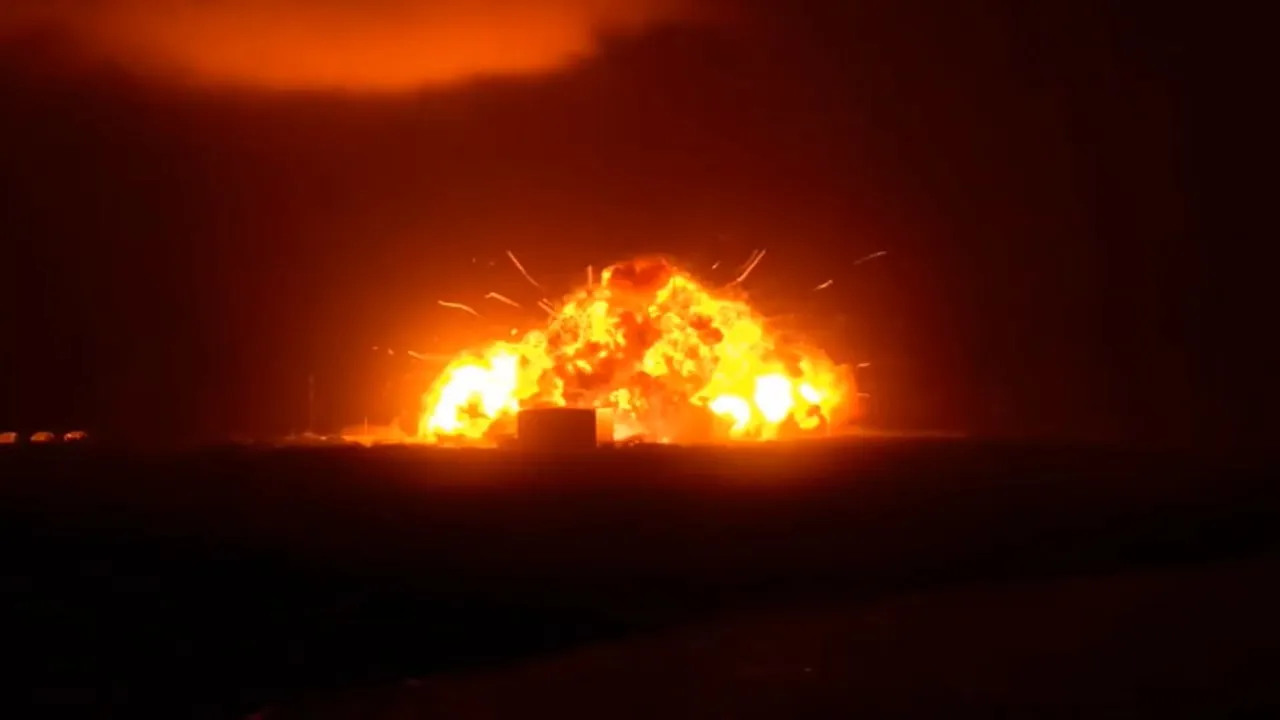

CAPE CANAVERAL, Fla. — The high-stakes race for the lunar surface suffered a fiery setback on Thursday night, May 28, when a heavy-lift New Glenn rocket belonging to Jeff Bezos’ Blue Origin catastrophically exploded on its launch pad.
The explosion, which shook nearby homes and briefly painted the Florida sky a brilliant orange, occurred just two days after NASA handed Blue Origin a series of lucrative, high-profile contracts to spearhead its ambitious new “Moon Base” initiative.
A Catastrophic “Anomaly” on the Space Coast
The disaster unfolded around 9:00 p.m. EDT at Cape Canaveral Space Force Station’s Launch Complex 36. Engineers were in the final countdown of a routine “static fire” engine test, a pre-launch check where the rocket’s engines are ignited while the vehicle remains securely bolted to the pad.
The rocket was being prepared for a June 4 mission to launch a batch of Amazon “Leo” internet satellites. Instead, as the engines ignited, a massive malfunction occurred at the base of the vehicle. Within seconds, a roiling fireball consumed the 320-foot-tall rocket, causing it to collapse into a spectacular conflagration that was visible for miles and rattled windows in nearby Cocoa Beach.

“All personnel are accounted for and safe,” Blue Origin founder Jeff Bezos posted later on X, acknowledging a “very rough day.”
NASA Administrator Jared Isaacman also responded to the incident via social media. “Spaceflight is unforgiving, and developing new heavy-lift launch capability is extraordinarily difficult,” Isaacman wrote, promising that NASA would cooperate with a thorough investigation to assess impacts on upcoming lunar timelines.
The Bitter Timing: NASA’s Grand Moon Base Reveal
The pad disaster stands in stark contrast to the triumphant atmosphere at NASA Headquarters in Washington just 48 hours prior. On Tuesday, May 26, Administrator Isaacman had unveiled a sweeping blueprint for “Moon Base”—humanity’s first permanent outpost on another world, situated at the lunar South Pole.
As part of a wave of nearly $1 billion in commercial contracts to jumpstart Phase 1 infrastructure, NASA heavily favored Blue Origin over its primary rival, Elon Musk’s SpaceX, selecting Bezos’ firm to anchor the very first uncrewed cargo run.
NASA’s multi-phase Moon Base plan outlined the following upcoming missions:
- Moon Base I (Fall 2026): Blue Origin was selected to fly its Blue Moon Mark 1 Endurance lander to the Shackleton Connecting Ridge. The lander is slated to carry specialized NASA gear, including stereo cameras to study thruster plumes and a laser retroreflective array for precision spacecraft navigation.
- Moon Base II & III (Late 2026): Cargo runs utilizing Astrobotic’s Griffin lander and Intuitive Machines’ Nova-C lander to deliver tech demonstrations and study mysterious “lunar swirls” on the surface.
- The Lunar Buggy Deliveries (Targeted for 2028): NASA awarded $219 million to Astrolab and $220 million to Lunar Outpost to design cutting-edge, crewed Lunar Terrain Vehicles (LTVs). Crucially, NASA awarded Blue Origin $188 million (with an additional $280.4 million option) specifically to serve as the celestial delivery driver tasked with launching and landing these rovers on the moon.
What This Means for the Artemis Program
The explosion leaves the timeline for both the uncrewed Moon Base missions and the broader Artemis program in sudden jeopardy.
The New Glenn rocket is not only central to the uncrewed 2026 cargo deliveries; its architecture forms the foundation for the massive human-rated landing systems Blue Origin is building for the crewed Artemis III (2027) and Artemis IV (2028) missions, where American astronauts intend to live and work on the moon for extended periods.
With Launch Complex 36 reportedly sustaining severe infrastructure damage and a likely Federal Aviation Administration (FAA) grounding looming, space analysts warn that Bezos’ timeline to fly a prototype lunar lander this fall is effectively shattered.
As the smoke clears in Florida, NASA engineers and private contractors face a looming question: can the commercial space industry rebuild fast enough to stay ahead of international competitors like China, or will the “science of survival” on the moon have to wait?