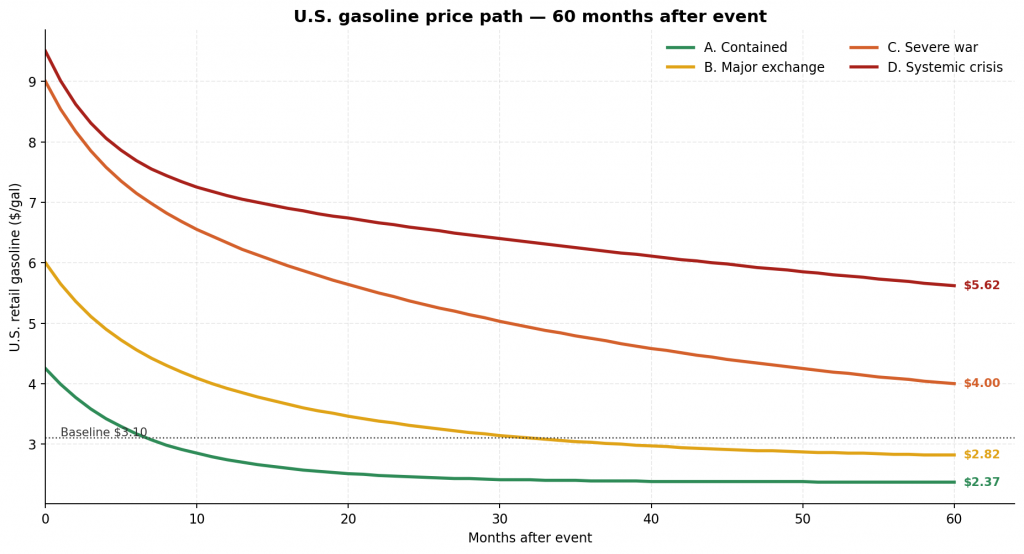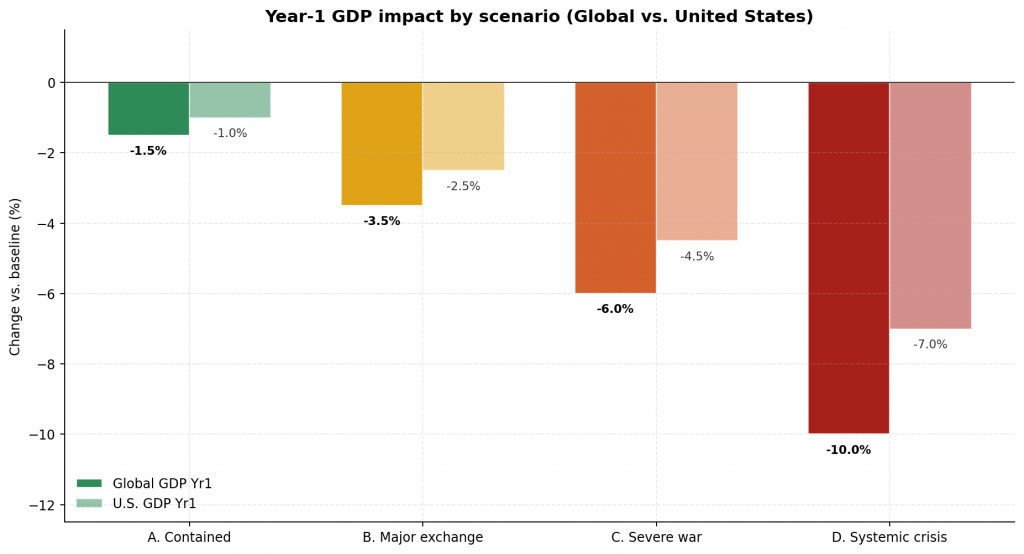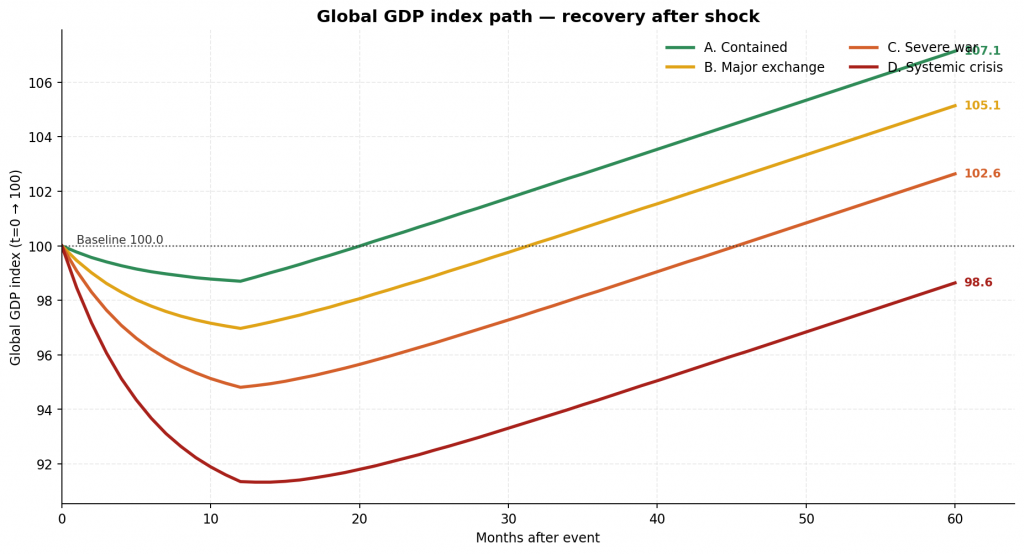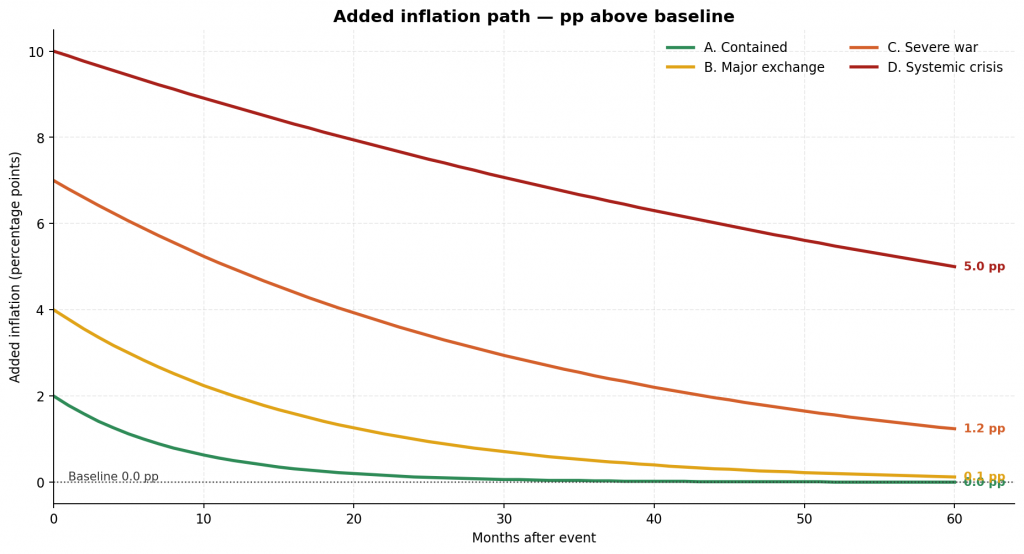
As gas prices rise significantly, and impact the every day consumer, I wanted to provide a look at one of the many potential alternatives : What could happen in a world where Iran achieves the ability to deliver a nuclear warhead to somewhere in Israel, and the potential hours after a detonation.
This is an opinion piece by Brandon.
Nuclear Exchange Between Israel and Iran: Strategic Logic and Global Economic Consequences
Abstract
This paper examines a hypothetical limited nuclear exchange between Iran and Israel, focusing on Israeli nuclear doctrine, immediate physical and societal impacts, and cascading global economic consequences. Israel’s posture emphasizes deterrence through assured retaliation. A successful nuclear strike on Israeli population centers would likely trigger rapid and decisive nuclear retaliation. Even a limited regional nuclear exchange would produce disproportionately large global economic shocks, including energy market disruption, financial contagion, and long-term climatic and trade effects.
1. Strategic Context: Israeli Nuclear Doctrine and Retaliation Logic
Israel’s nuclear posture is commonly described as deliberate ambiguity combined with deterrence through assured retaliation¹.

1.1 Second-Strike Capability
Israeli doctrine assumes survivability of retaliatory forces, including submarine-based systems. A nuclear first strike that fails to eliminate these assets guarantees retaliation².
1.2 “Samson Option” Logic
Analysts widely interpret Israeli doctrine as permitting large-scale retaliation if national survival is threatened³.
1.3 Escalation Dominance
Israeli strategy aims to end conflicts decisively rather than proportionally, and ambiguity may shift toward explicit nuclear use if deterrence fails⁴.
Implication
In a scenario involving nuclear strikes on Israeli cities, Israel would likely:
- Retaliate within hours to days
- Use MRBMs, aircraft, and potentially SLBMs
- Target a mix of major population centers and strategic infrastructure
2. Immediate Effects of a Limited Nuclear Exchange
2.1 Urban Destruction and Casualties
A single 20 to 50 kiloton nuclear detonation in a dense city can cause hundreds of thousands of immediate casualties, with additional long-term fatalities from burns, radiation, and infrastructure collapse⁵.
2.2 Israeli Retaliation Effects
Israeli counterstrikes on Iranian cities and infrastructure would likely result in millions of cumulative casualties and widespread destruction of industrial and energy systems.
2.3 Regional Fallout
Fallout would likely affect neighboring countries such as Jordan, Lebanon, and Gulf states, and could contaminate Mediterranean trade routes.
3. Escalation Dynamics
3.1 Regional War Expansion
Iranian strategy emphasizes escalation rather than calibrated response⁶. This would likely draw in proxy forces and potentially external powers.
3.2 Nuclear Threshold Breakdown
Once nuclear weapons are used, the global norm against their use weakens, increasing the risk of broader nuclear escalation.
4. Global Economic Impacts
4.1 Energy Markets and Consumer Price Transmission
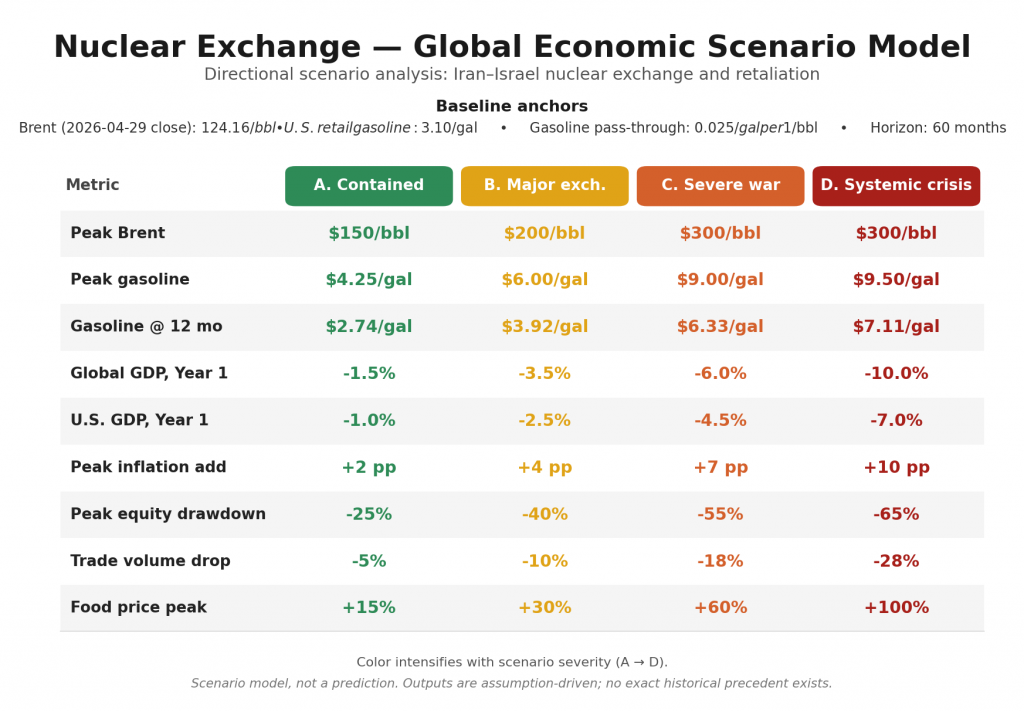
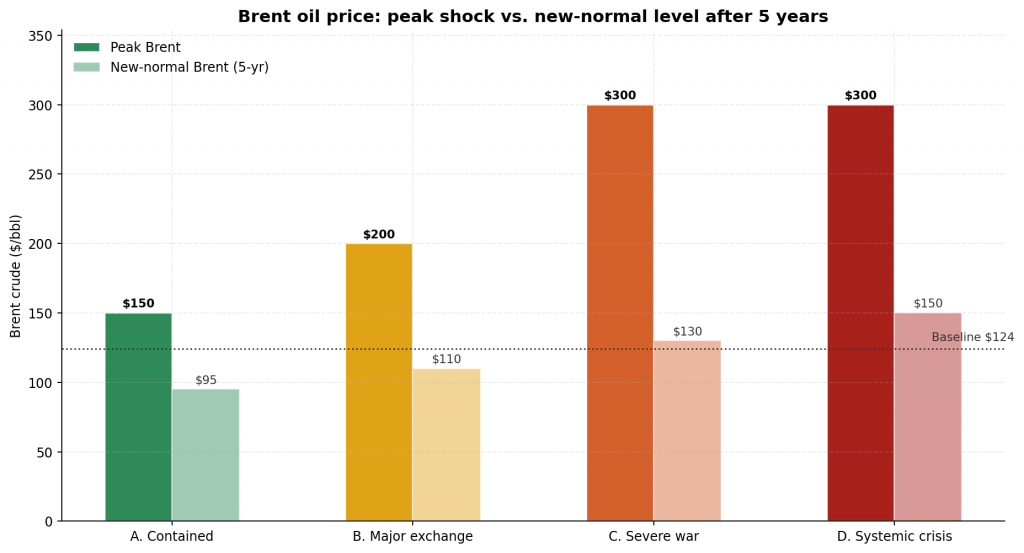
The Middle East supplies roughly 30 percent of global oil production and controls key chokepoints such as the Strait of Hormuz. A nuclear exchange would likely disrupt or halt exports, causing oil prices to spike into the range of 150 to 300 dollars per barrel.
Transmission to Consumer Gasoline Prices
Historically, U.S. gasoline prices correlate strongly with crude oil prices. A commonly used approximation is:
- Every 10 dollar increase in oil prices adds about 0.25 dollars per gallon to gasoline prices
Using this relationship:
- At 150 dollars per barrel
Expected gasoline price: approximately 5.50 to 6.50 dollars per gallon - At 200 dollars per barrel
Expected gasoline price: approximately 7.00 to 8.50 dollars per gallon - At 300 dollars per barrel
Expected gasoline price: approximately 10.00 to 12.00 dollars per gallon
These estimates assume functioning refining and distribution systems. In a conflict scenario, additional factors could push prices even higher:
- Shipping insurance costs spike or become unavailable
- Refinery disruptions due to supply mismatch
- Panic buying and rationing behavior
Secondary Economic Effects
- Transportation costs rise sharply, increasing prices of all goods
- Airline and logistics sectors experience severe contraction
- Inflation accelerates globally, especially in energy-importing nations
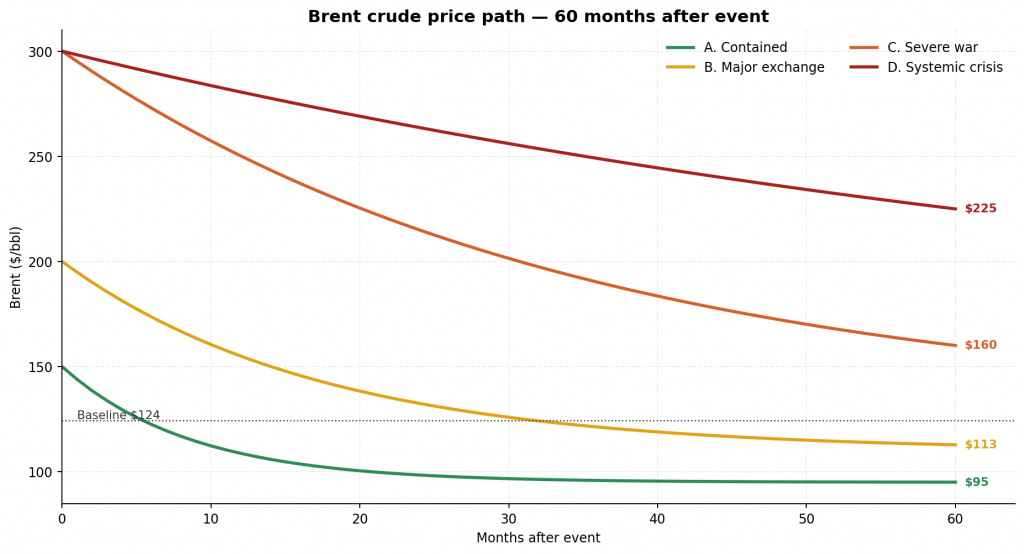
Normalization Timeline
Recovery depends on several variables:
Short term, 0 to 6 months
- Extreme volatility
- Strategic petroleum reserves released
- Prices remain elevated above 120 dollars per barrel
Medium term, 6 to 24 months
- Partial restoration of supply from non-Middle East producers such as the United States, Brazil, and Norway
- Demand destruction due to recession lowers prices
- Prices may stabilize in the 90 to 140 dollar range
Long term, 2 to 5 years
- Infrastructure rebuilding if conflict is contained
- New supply investments come online
- Prices could normalize toward historical ranges, though likely with a higher baseline due to geopolitical risk
If the Strait of Hormuz remains closed or if regional instability persists, normalization may not occur for several years, and structurally higher energy prices could become the new baseline⁷.
4.2 Financial System Shock
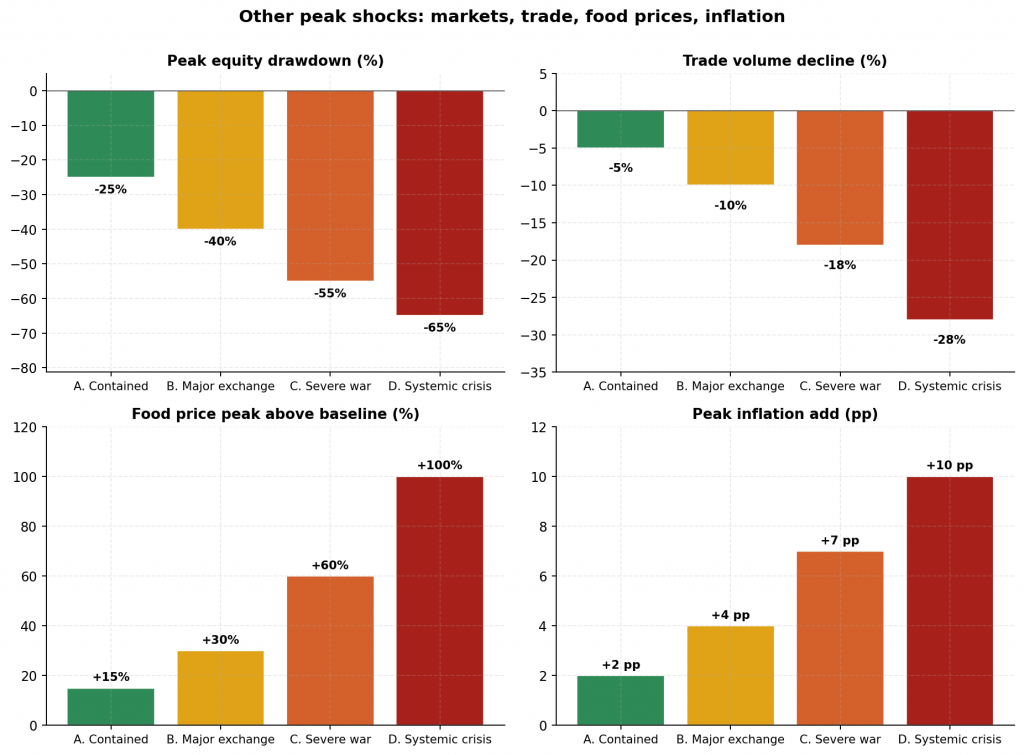
Immediate effects would include equity market collapse, a flight to safe-haven assets, and liquidity contraction. Insurance markets would face systemic stress due to war exclusions and uncertainty.
4.3 Trade and Supply Chains
Disruptions to maritime routes such as the Suez Canal and Red Sea would increase shipping costs and delay global trade. Manufacturing supply chains, particularly in Europe and Asia, would slow significantly.
4.4 Technology and Capital Flows
Israel’s role in cybersecurity and technology innovation means its disruption would impact global venture capital and high-tech industries. Even conventional conflicts have shown measurable economic impacts⁸.
4.5 Climatic and Agricultural Effects
Regional nuclear war scenarios indicate that soot injection into the atmosphere could reduce global temperatures and agricultural output, increasing food insecurity worldwide⁹.
5. Comparative Modeling Insights
Studies of regional nuclear conflicts, such as India and Pakistan scenarios, suggest that even limited exchanges could reduce global agricultural output and impact billions through food shortages⁹.
6. Synthesis: Likely Outcome Pattern
Phase 1, 0 to 72 hours
- Nuclear detonations and retaliation
- Immediate oil and financial market shock
Phase 2, days to weeks
- Regional escalation
- Collapse of energy flows
- Severe global downturn
Phase 3, months to years
- Prolonged recession
- Trade fragmentation
- Food supply stress
7. Key Analytical Conclusion
Israel would almost certainly respond to a nuclear attack with overwhelming retaliation. Even a limited exchange involving 20 to 50 kiloton weapons would produce systemic global economic disruption. The scale of impact would be driven less by the number of weapons and more by the disruption to energy markets, financial systems, and global trade networks.
Footnotes and Sources
- Military Strategy Magazine, “Israel’s Nuclear Posture: Intellectual Antecedents and Doctrinal Foundations”
https://www.militarystrategymagazine.com/article/israels-nuclear-posture-intellectual-antecedents-and-doctrinal-foundations/ - Begin-Sadat Center for Strategic Studies, “After the Iran War: Israel and the Threat of Nuclear War”
https://besacenter.org/after-the-iran-war-israel-and-the-threat-of-nuclear-war/ - Modern War Institute at West Point, “Israel’s Samson Option in an Interconnected World”
https://mwi.westpoint.edu/israel-samson-option-interconnected-world/ - Jewish News Syndicate, “Iran’s Nuclear Proxies vs Israel’s Nuclear Ambiguity”
https://www.jns.org/opinion/louis-rene-beres/irans-nuclear-proxies-vs-israels-nuclear-ambiguity - International Campaign to Abolish Nuclear Weapons, “What Would Happen If Nuclear Weapons Were Used”
https://www.icanw.org/what_would_happen_if_nuclear_weapons_were_used - Center for Strategic and International Studies, “Iran’s War Strategy: Don’t Calibrate, Escalate”
https://www.csis.org/analysis/irans-war-strategy-dont-calibrate-escalate - U.S. Energy Information Administration, “Oil Market and Price Impacts of Supply Disruptions”
https://www.eia.gov - Reuters, “Economic Effects of Middle East Conflict”
https://www.reuters.com - Rutgers University, “Global Famine After Regional Nuclear War”
https://climate.envsci.rutgers.edu/nuclear/