
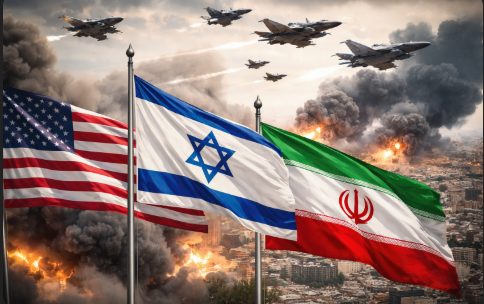

WASHINGTON, D.C. — President Donald Trump on February 28, 2026, announced the start of what he described as “major combat operations” against Iran, marking a dramatic escalation in tensions and the most significant U.S. military action in the region since last year’s brief but intense conflict.
In a statement, he told the people of Iran, the freedom fighters to stay hidden and inside as bombs will drop everywhere, when the dust settles, to “take over their government,” that it would probably be the only chance they will get for a generation.”
The operation is being carried out jointly with Israel and follows months of rising strain over Iran’s nuclear program, stalled diplomatic negotiations, and the aftermath of a short war between Israel and Iran in June 2025.
Large-Scale Strikes Reported
According to administration officials, U.S. and Israeli forces launched coordinated strikes targeting Iranian nuclear facilities, ballistic missile sites, and elements of Iran’s naval forces.

In remarks announcing the action, Trump called for regime change in Tehran, urging the Iranian people to “take over your government” and declaring that “the hour of your freedom is at hand.” He also vowed to “annihilate” Iran’s navy and dismantle its missile infrastructure, framing the offensive as necessary to counter what he described as imminent threats to U.S. national security.
Iranian Retaliation
Iran responded swiftly, launching drones and missiles toward Israel and targeting U.S. military installations across the Middle East, including bases in Bahrain, Kuwait, Qatar and the United Arab Emirates.
Additional strikes and proxy activity have been reported in Syria, Jordan, Saudi Arabia and Iraq, raising concerns of a widening regional conflict.
Airspace has been closed in several countries, including Iraq, Jordan and the UAE, as governments assess security risks. Global oil markets are also on edge, given that a significant portion of the world’s oil supply moves through the strategically critical Strait of Hormuz.
Background: The 2025 “12-Day War”
The current escalation follows a shorter but intense conflict in June 2025, sometimes referred to as the “12-Day War.”
On June 22, 2025, U.S. forces launched Operation Midnight Hammer, during which B-2 stealth bombers struck Iranian nuclear facilities in Natanz, Fordow and Isfahan with bunker-buster munitions. At the time, Trump said the sites had been “obliterated,” though later intelligence assessments indicated Iran’s nuclear program had been set back by approximately two years rather than destroyed entirely.
A ceasefire between Israel and Iran was brokered on June 24, 2025, temporarily halting hostilities.
Domestic Political Reaction
The renewed military campaign has sparked immediate debate in Washington. Several lawmakers have criticized the strikes as unconstitutional, arguing that Congress did not authorize the use of force.
Among the critics are Rep. Ilhan Omar and Rep. Thomas Massie, who have described the action as an “illegal war.” Supporters of the president, however, argue that the administration is acting within its authority to defend U.S. forces and interests abroad.
The move represents a significant shift from Trump’s previous campaign messaging centered on an “America First” approach and ending prolonged overseas conflicts. Administration officials say the current intervention is limited in scope and designed to neutralize specific threats rather than initiate an open-ended war.
In remarks addressing the nation, President Donald Trump said the Iranian regime poses a direct threat.
“The Iranian regime seeks to kill,” Trump said. “We need to make sure they don’t have nuclear capabilities for the future.”
The president framed the military action as a preventative measure aimed at stopping Iran from advancing its nuclear program and targeting U.S. interests and allies in the region.
As of Saturday evening, fighting was ongoing, and international leaders were urging restraint amid fears that the confrontation could broaden into a wider regional war.