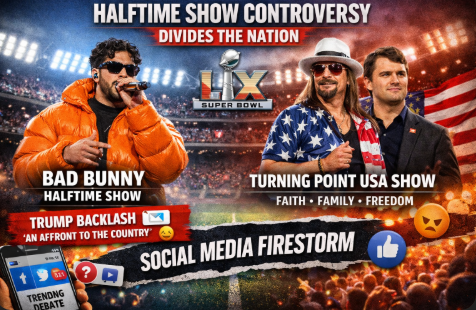

Republican lawmakers are urging the Federal Communications Commission (FCC) to investigate Bad Bunny’s Super Bowl LX halftime performance, escalating what has become one of the most politically charged Super Bowl shows in recent memory.
Rep. Randy Fine (R-FL) sent a formal letter to FCC Chairman Brendan Carr on February 10, 2026, calling for a “full investigation” into the February 8 broadcast. Fine and other conservatives argue that elements of the performance violated broadcast standards and are seeking maximum penalties, including potentially heavy fines and even the revocation of broadcast licenses for NBC and the NFL.
FACT CHECK – As of February 11, 2026, the FCC has not announced any formal probe or enforcement action.
Viral claims circulating on social media alleging that Bad Bunny has already been fined $10 million by the FCC are false. No such penalty has been issued.
A High-Energy, Culturally Focused Performance
Bad Bunny headlined the halftime show with a high-energy, all-Spanish set that featured hits including “Tití Me Preguntó,” “Safaera,” “Yo Perreo Sola,” and “Monaco.” The performance celebrated Puerto Rican culture and included guest appearances by Lady Gaga, who joined him for “Die with a Smile,” and Ricky Martin, who performed “Lo Que Le Pasó a Hawaii.”
Some Republican critics have pointed to the lyrical content of certain songs, which in their original versions contain explicit language. During the live broadcast, however, Bad Bunny altered or mumbled portions of lyrics, seemingly to comply with broadcast standards. It was curious that the NFL and the Station did not offer subtitles.
Political Flashpoint
Beyond concerns about language, the performance sparked broader political debate due to its symbolism and messaging.
The show concluded with Bad Bunny saying “God Bless America” before reciting the names of more than 20 countries across North and South America. Supporters viewed the moment as a celebration of Pan-American unity, while critics argued it challenged “America First” ideology by framing “America” as the entire hemisphere rather than solely the United States.
The artist also displayed the Puerto Rican flag featuring a light blue triangle, a version historically associated with Puerto Rico’s independence and sovereignty movements.
Ricky Martin’s performance of “Lo Que Le Pasó a Hawaii” drew attention for its comparison between Hawaii’s colonization and Puerto Rico’s political status, with themes addressing gentrification and cultural preservation. During “El Apagón,” dancers climbed faux electrical pylons that appeared to explode — imagery widely interpreted as referencing Puerto Rico’s ongoing power grid struggles and criticism of the federal response to Hurricane Maria.
The performance unfolded against the backdrop of heightened national debate over immigration policy. As the show concluded, a screen displayed the message: “The only thing more powerful than hate is love,” while Bad Bunny held a football inscribed with the words “Together We Are America.”