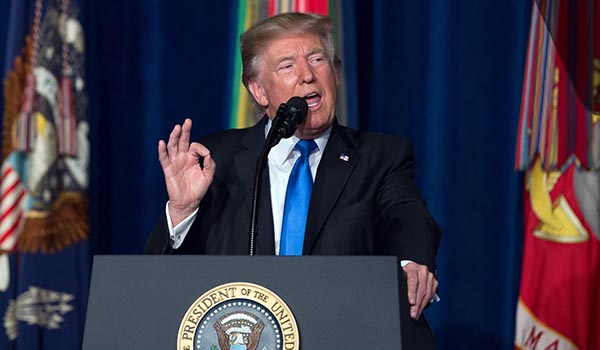

NEW YORK — President Donald Trump used his address to the United Nations General Assembly Tuesday to defend his administration’s foreign-policy record, criticize international institutions and argue that the United States is taking a more assertive role on the world stage.
Speaking at the 81st session of the U.N. General Assembly, Trump highlighted what he described as a series of diplomatic, military and economic accomplishments since returning to office.
The White House said Trump’s message centered on strengthening U.S. sovereignty, protecting American interests and reducing what the administration views as unnecessary international commitments.
Among the administration’s stated accomplishments are efforts to reduce U.S. spending connected to the United Nations, withdrawal from dozens of international organizations, sanctions against the International Criminal Court and withdrawal from the U.N. Human Rights Council and the U.N. Relief and Works Agency, or UNRWA.

Trump also criticized what he described as attempts by international organizations to impose policies on the United States involving climate, migration and artificial intelligence.
Iran and Middle East dominate speech
A significant portion of Trump’s address focused on Iran and the ongoing conflict involving the United States.
Trump defended U.S. military action against Iran and reiterated his opposition to Iran obtaining a nuclear weapon. He warned that the United States could take further military action if a diplomatic agreement is not reached. Reuters reported that Trump said he expected a potential agreement with Iran after the November midterm elections.
The president also discussed Gaza and his administration’s efforts toward a broader Middle East settlement. The White House credited Trump with helping secure the release of hostages and advancing what it described as a path toward lasting regional stability.
Western Hemisphere and cartels
Trump also focused heavily on the Western Hemisphere, including U.S. efforts against drug cartels.
He said his administration has designated cartels as Foreign Terrorist Organizations and authorized the military to take action against them. Trump also highlighted the administration’s Shield of the Americas initiative, which the White House describes as a regional economic and security alliance.
Reuters reported that Trump pledged to use U.S. military power when necessary to protect American interests in the Western Hemisphere and described the administration’s efforts against cartels as a major component of its regional strategy.
Trump also discussed Cuba and Venezuela during the speech, arguing that his administration’s policies are intended to increase pressure on governments he considers hostile to U.S. interests.
U.N. criticism
Trump continued his criticism of the United Nations, arguing that the organization has expanded beyond what he considers its appropriate role.
He called for reductions in international bureaucracy and opposed what he described as efforts toward greater global control, including international taxation and regulation of artificial intelligence.
Trump also renewed his criticism of the International Criminal Court and called on member nations to withdraw from the organization.
Defense and American industry
The president also pointed to increased defense spending among NATO members, expanded U.S. defense production and efforts to bring manufacturing and other critical industries back to the United States.
The White House said the administration’s policies have generated new investment and jobs while strengthening the nation’s defense industrial base.
Trump also discussed artificial intelligence, saying the United States should resist international efforts to impose what he characterized as a global regulatory framework on the technology. Reuters reported that Trump referred to the technology as “super intelligence” and said the Justice Department would monitor the industry for potential violations.
The address comes as world leaders gather in New York for the annual General Assembly, with conflicts involving Iran, Ukraine and the Middle East among the major issues facing the international community.