
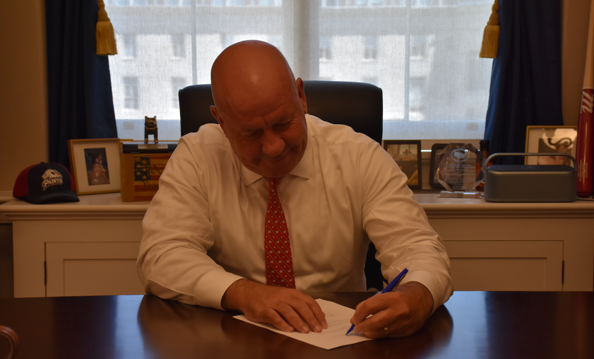

WASHINGTON, D.C. — U.S. Congressman Dave Taylor (OH-02) introduced federal legislation on Wednesday aimed at permanently reshaping how the Department of Housing and Urban Development (HUD) enforces anti-discrimination laws.
The Housing Regulatory Clarity Act seeks to eliminate HUD’s ability to use the legal standard known as “disparate impact” when regulating the American housing market. If passed, the bill would formally codify an executive action taken last year by the White House to scale back federal housing oversight.
Joining Taylor as original cosponsors on the bill are Representatives Paul Gosar (AZ-09), Mike Collins (GA-10), Mike Rulli (OH-06), and Matt Van Epps (TN-07).
The Debate Over ‘Disparate Impact’
Under the Fair Housing Act, HUD has historically utilized the disparate impact standard to penalize housing providers, lenders, and sellers whose policies inadvertently create a statistical disadvantage for protected classes—such as racial minorities or disabled individuals—even if there was no explicit intent to discriminate.

Proponents of the standard argue it is a vital tool for uncovering systemic bias, pointing to historical data. According to the U.S. Census Bureau’s 2024 housing data, persistent gaps remain in American homeownership rates, with White households at approximately 74%, compared to 45.7% for Black households and 49.9% for Hispanic households. Advocates of the rule contend that neutral-sounding policies, like strict credit scoring or criminal background checks, can disproportionately lock minority groups out of housing.
However, Taylor and his colleagues argue the policy amounts to regulatory overreach that punishes innocent property owners based purely on statistical outcomes rather than discriminatory intent.
“Instead of ensuring fairness in the housing market, HUD’s implementation of disparate impact has imposed undue burdens on housing providers and undermined the principle of equal opportunity outlined in our Constitution,” Congressman Taylor said in a statement. “I’m proud to lead my colleagues in restoring common sense to our housing market, untying the hands of landlords and sellers, and getting the government out of the way.”
Codifying a Trump Executive Order
The Republican-led bill acts as a legislative anchor for Executive Order 14281, which President Trump signed in April 2025. That executive order restricted federal agencies from deploying disparate-impact liability and ordered a comprehensive review to rescind existing guidelines utilizing the standard. Because executive orders can be easily overturned by future administrations, Taylor’s bill aims to permanently write the prohibition into federal statute.
Congressman Gosar praised the bill for targeting what he described as weaponized theories by “unelected bureaucrats.” Meanwhile, Congressman Collins noted that the fear of frivolous federal lawsuits could inadvertently hurt the market by discouraging landlords from renting out their homes, thereby constricting the available housing supply.
Rep. Van Epps echoed constitutional concerns, stating the policy has pressured institutions to treat Americans differently based on race. “The Housing Regulatory Clarity Act makes clear that agencies like HUD cannot use disparate-impact standards to justify racial discrimination and instead must focus on serving every American fairly and equally under the law,” Van Epps said.
Industry Backing
The legislation has garnered strong support from insurance and real estate trade groups who have long complained about the legal ambiguities associated with disparate impact liability.
The National Association of Mutual Insurance Companies (NAMIC) formally endorsed the bill upon its introduction.
“As President Trump has noted, disparate-impact liability undermines our national values and threatens the bedrock American principle that all citizens are treated equally under the law,” said Jimi Grande, NAMIC’s Senior Vice President of Federal and Political Affairs. “We commend the bill sponsors and encourage its swift passage to ensure that the agency charged with responsibility for housing treats all individuals equally before the law.”
The bill has been referred to the appropriate house committee for review.