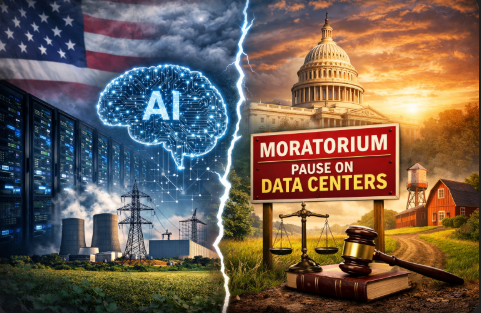

As artificial intelligence infrastructure rapidly expands across the United States, a growing number of townships, cities, and states are pressing pause.
Local governments from Michigan to Ohio are debating — and in many cases enacting — temporary moratoriums on new data center development, citing concerns over noise, water consumption, and strain on electrical grids. The debate has reached Pickaway County and surrounding communities, where officials are discussing whether to temporarily halt projects while zoning rules are reviewed.
But as the number of moratoriums grows, so do questions about whether they are legal.
What Is a Moratorium?
The Oxford Dictionary defines a moratorium as “a temporary prohibition of an activity.” That word — temporary — is critical.
Courts generally uphold moratoriums when they are narrowly tailored and used as legitimate planning tools, typically lasting six to 12 months. Municipalities often use them to prevent a rush of permit applications while updating zoning codes or studying environmental and infrastructure impacts.
Communities frequently cite concerns about facilities exceeding 5 megawatts of power use, increased noise levels, and heavy water demand.
However, moratoriums that appear permanent or are used to block a specific project outright may face legal challenges.
Legal Risks and Limits
Local governments rely on their “police power” — authority to protect public health, safety, and welfare — to justify temporary pauses. Courts often support moratoriums designed to allow time for environmental studies or zoning updates.
But the legal footing can become shaky under certain circumstances:
- Exclusionary Zoning: A moratorium that effectively bans data centers entirely may violate state laws if there is a demonstrated need for such facilities.
- Vested Rights: If a developer has already secured permits or begun construction, a retroactive moratorium may not hold up in court.
- State Restrictions: Some states have enacted laws limiting how local governments can “down-zone” properties without landowner consent.
- Authority Questions: In some cases, legal experts argue local boards may lack the authority to impose moratoriums without following strict legislative procedures.
As of early 2026, at least 19 municipalities in Michigan have enacted temporary pauses, while several Ohio townships — including communities near Columbus — have adopted moratoriums ranging from 90 days to nine months.
State Legislative Efforts
In New York, Senate bill S.9144 proposes a three-year statewide moratorium on data centers exceeding 20 megawatts while environmental and utility impact studies are conducted.
In Pennsylvania, lawmakers have proposed similar legislation aimed at researching infrastructure strain and safety standards.
Meanwhile, communities in Ohio continue evaluating temporary pauses as data center proposals increase in suburban and rural areas.
Federal Fight Over AI Infrastructure
At the federal level, no nationwide moratorium currently exists — but a political fight is intensifying.
In late 2025, U.S. Sen. Bernie Sanders called for a national pause on data center construction, arguing that rapid AI expansion is outpacing democratic oversight. More than 230 environmental and consumer advocacy groups have petitioned Congress for a moratorium, warning that soaring electricity and water use could drive up utility costs.
A bipartisan proposal from Sens. Josh Hawley and Richard Blumenthal would bar data centers from passing energy costs onto residential ratepayers, effectively requiring them to build dedicated power sources.
At the same time, the executive branch has taken the opposite approach. The current administration has issued executive actions aimed at accelerating federal permitting for AI data centers and identifying state-level regulations that could be challenged. Agencies have been directed to explore streamlined environmental review processes under the National Environmental Policy Act (NEPA), seeking to fast-track large infrastructure projects.
Federal officials argue that delays could undermine U.S. competitiveness and national security in the global AI race.
A Clash of Priorities
At the heart of the debate is a fundamental policy conflict.
Supporters of rapid AI infrastructure development say moratoriums threaten economic growth and technological leadership. Critics warn that unchecked expansion could overwhelm local power grids, increase water consumption dramatically, and shift financial burdens onto households.
Forecasts suggest that, by 2028, AI-related data centers could consume water volumes equivalent to hundreds of thousands — potentially up to one million — Olympic-sized swimming pools annually nationwide.
For now, the legality of local moratoriums remains a case-by-case question, largely determined by state law and judicial interpretation. Without a federal statute mandating or prohibiting them, courts will continue to decide whether temporary pauses are reasonable planning tools — or unlawful barriers to development.
As AI infrastructure spreads into more rural counties and small communities, including those in Pickaway County, the debate over how — and whether — to hit pause is likely far from over.