
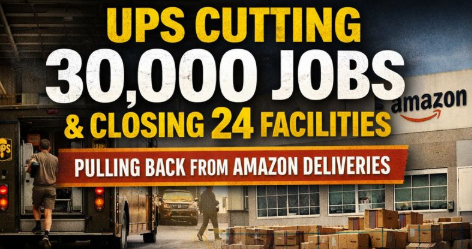

United Parcel Service announced Tuesday it will eliminate up to 30,000 additional jobs and shut down 24 facilities in 2026, continuing a major restructuring effort tied to reduced delivery volumes from Amazon and a broader shift toward higher-margin business.
Despite the job cuts, UPS shares climbed about 4% in midday trading after the company reported fourth-quarter earnings that beat Wall Street expectations and issued a stronger-than-expected revenue outlook. Shares of rival FedEx also rose, gaining roughly 2.6%.
UPS has been steadily scaling back its relationship with Amazon, its largest customer and an increasingly direct competitor. In early 2025, the company said it would accelerate plans to reduce millions of low-profit Amazon deliveries, calling the business “extraordinarily dilutive” to margins. That strategy has intensified as overall demand for package delivery services remains soft across the industry.
The company has already undergone significant downsizing. In 2025 alone, UPS eliminated about 48,000 jobs, offered driver buyouts, and closed operations at 93 buildings as Amazon shipping volumes declined. The latest round of reductions will largely occur through employee attrition and another buyout offer for full-time drivers. Chief Financial Officer Brian Dykes emphasized that layoffs are not planned.

UPS employed about 490,000 workers in 2024, including nearly 78,000 management employees, according to its most recent annual report. Updated employment figures for 2025 were not immediately available. With a largely unionized workforce, the company expects many of the cuts to come from not refilling positions as part-time employees leave.
Separately, UPS is also working to stabilize shipping volumes following the end of U.S. duty-free “de minimis” treatment for low-value e-commerce imports, which had benefited major China-linked retailers such as Shein and Temu.
Looking ahead, UPS projected 2026 revenue of $89.7 billion, up from $88.7 billion in 2025. Analysts had expected revenue closer to $88 billion, according to LSEG data, making the forecast a positive surprise for investors.