

GROVE CITY, Ohio — As one of the fastest-growing communities in central Ohio, Grove City is preparing for significant population increases over the next 25 years with a comprehensive land use strategy designed to balance development, sustainability and preservation.
City leaders say the updated land use framework, part of the GroveCity2050 plan, aims to guide growth in a way that protects the character residents value while ensuring the city remains fiscally strong.
Central Ohio’s Growth Driving Local Planning
The seven-county central Ohio region — including Franklin, Delaware, Fairfield, Licking, Madison, Pickaway and Union counties — is the fastest-growing region in the state. Since 2000, the region has added nearly 350,000 residents and now totals about 1.9 million people.
By 2050, regional planners project the population could grow to 2.4 million — or potentially even higher if recent growth trends continue.

Grove City itself has added roughly 12,000 residents since 2000 and is projected to grow by another 10,500 to 15,000 residents by 2050. Current projections suggest the city’s population could reach approximately 54,000 by mid-century — a 38 percent increase from 2015 levels.
Demographic Shifts Changing Housing Demand
City planners say future growth will look different from the past.
While growth between 1990 and 2010 was driven largely by residents ages 35 to 64, future growth is expected to come primarily from adults over 65 and young adults under 35. Households without children are projected to grow significantly faster than households with children.
Locally, Grove City has already seen its fastest growth among residents under 35 and those over 55. The 55–64 age group increased by more than 100 percent since 2000.
These demographic shifts are influencing housing preferences. National studies show rising demand for:
- Walkable neighborhoods
- Smaller lots and attached housing
- Low-maintenance living options
- Mixed-use environments near shops and services
City officials say the land use plan is designed to respond to those trends.
Prioritizing Infill Over Sprawl
A major goal of the updated plan is to focus development in areas already served by infrastructure — rather than expanding outward into undeveloped farmland.
Currently, about 40 percent of the planning area contains potentially developable land, much of it south and west of the existing city boundary. However, sewer infrastructure limits how quickly and where development can occur.
Officials say extending utilities south of State Route 665 would require significant investment.
Instead, the city plans to:
- Encourage redevelopment of underused properties
- Promote infill construction near existing neighborhoods
- Direct growth toward designated corridors and activity centers
- Preserve environmentally sensitive areas
Development Pipeline and Housing Goals
Approved and developing residential projects already provide capacity for more than 1,000 new housing units. Regional projections suggest Grove City will need approximately 7,700 additional housing units by 2050 — an average of 220 new homes per year.
Before the 2008 recession, the city exceeded that pace. In recent years, construction has averaged closer to 135 units annually.
Large-scale developments such as the Beulah Park redevelopment and the growing medical campuses of Mount Carmel and OhioHealth are expected to stimulate additional residential demand.
Land Use Categories and Character Areas
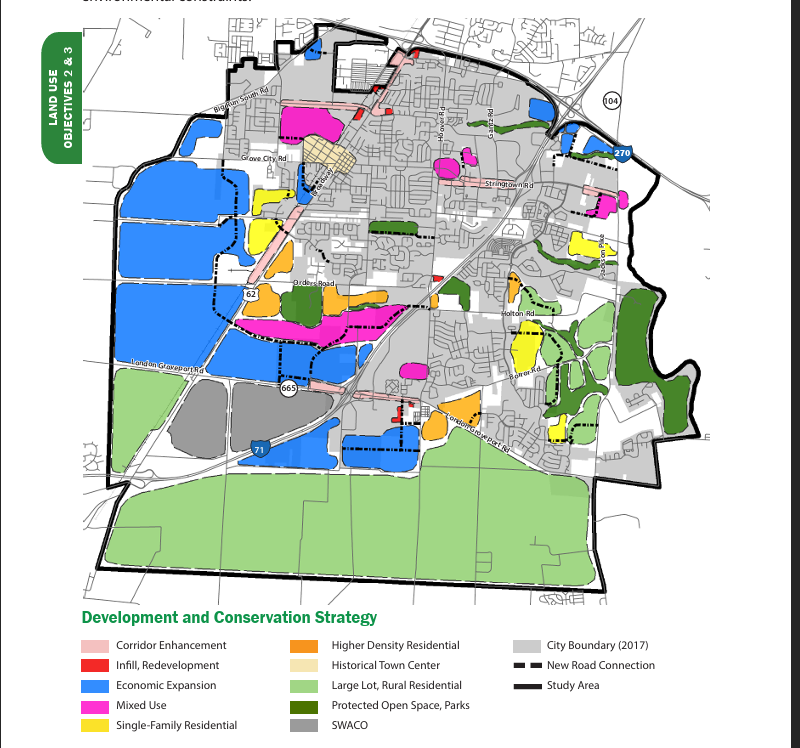
The updated framework introduces 16 “character types” that define how different areas of the city should develop. These range from:
- A walkable Town Center Core
- Mixed-use employment centers
- Tech-flex and research districts
- Commercial corridors
- Suburban neighborhoods of varying densities
- Conservation neighborhoods that preserve open space
- Rural “Edge Living” areas
- Park and open space designations
Officials say the majority of land will remain consistent with its existing character, but designated “areas of change” will accommodate new growth patterns and mixed-use development.
Focus on Town Center and Gateways
The historic Town Center remains a priority for investment and revitalization. More than $34 million was invested in the district between 2015 and 2016, including:
- The new Grove City Library
- Broadway Station Apartments
- The Pedestrian Promenade
- The Gold Star Families Memorial
City leaders plan continued updates to zoning, parking strategy and public realm improvements such as streetscape enhancements, lighting and pedestrian connections.
Parks and Sustainability Commitments
Grove City currently provides 8.4 acres of public parkland per 1,000 residents — below its city code goal of 20 acres. However, when including the 620-acre Scioto Grove Metro Park, that figure rises to nearly 25 acres per 1,000 residents.
The plan calls for:
- Requiring park and trail connections in new developments
- Exploring a new community recreation or sports complex
- Expanding green infrastructure and low-impact development practices
- Encouraging solar, rain gardens and permeable pavement
- Considering urban agriculture and sustainability-themed neighborhoods
The city is also participating in regional sustainability initiatives and exploring certification programs to benchmark progress.
Fiscal Impacts of Growth
City officials note that land use decisions directly impact finances.
Ohio cities rely heavily on income taxes generated by jobs within their boundaries. As a result, Grove City benefits most from office, industrial and research uses that create high-paying jobs.
Residential growth, while important, generates less municipal revenue and can increase demand on schools and infrastructure.
By strategically balancing housing, employment centers and open space, leaders say Grove City can accommodate growth while maintaining long-term fiscal health.
Looking Ahead
The Development and Conservation Strategy map identifies where growth should be encouraged and where it should be limited. Key priorities include:
- Updating zoning codes to reflect character-based planning
- Encouraging redevelopment of key sites
- Expanding housing diversity
- Preserving green space
- Coordinating planning efforts with neighboring townships and regional agencies
City officials say the ultimate goal is deliberate, thoughtful land use that strengthens neighborhoods, supports economic vitality and preserves the community’s character for generations to come.